
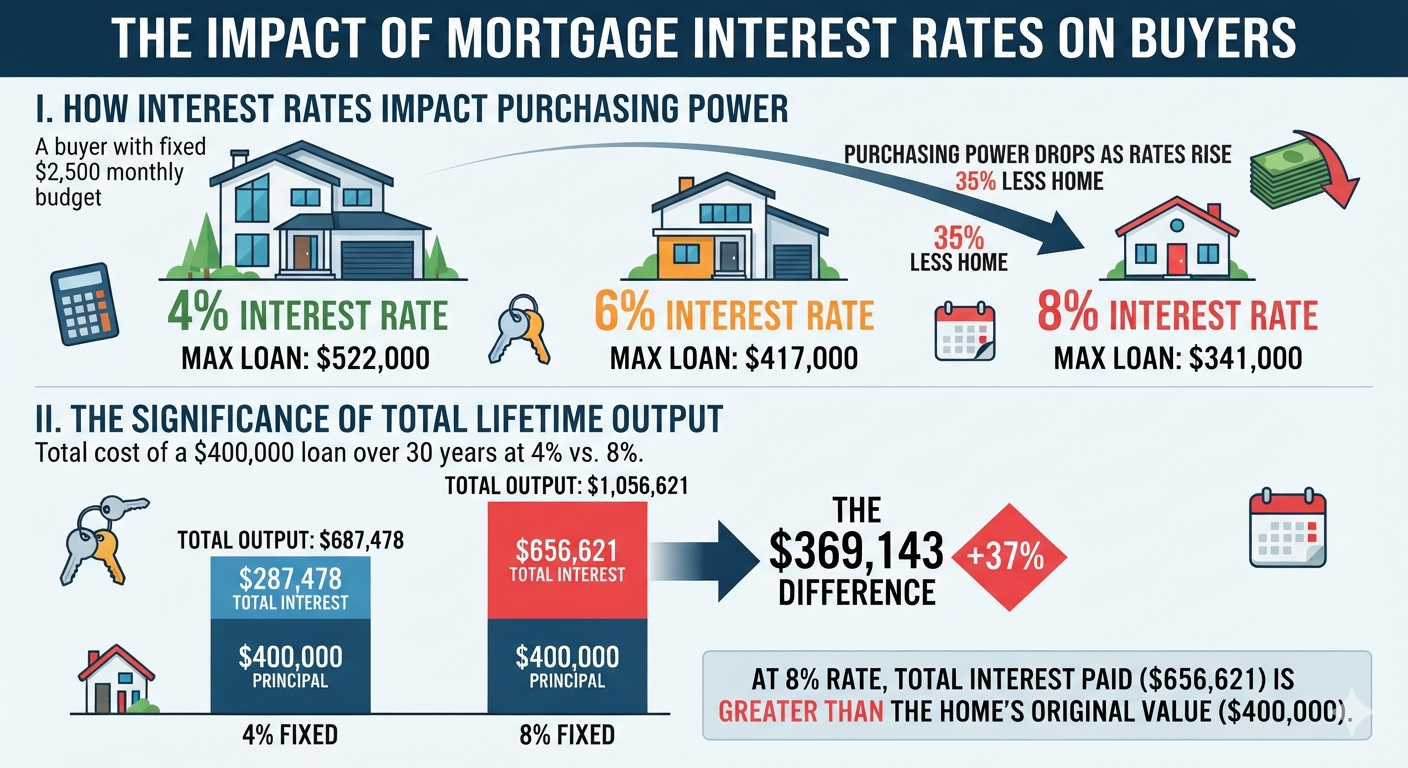
Mortgage interest rates directly dictate your home purchasing power and the long-term cost of your loan. Higher rates increase your monthly payments, reduce the maximum loan size you can qualify for, and dramatically inflate the total amount of money you pay back over time.
1. Purchasing Power Drops as Rates Rise
When interest rates go up, your monthly principal and interest payment increases. Since lenders limit your loan size based on a strict monthly debt-to-income (DTI) ratio, a higher rate directly shrinks the maximum purchase amount you can afford.
To visualize this impact, consider a buyer with a fixed $2,500 monthly budget for principal and interest on a 30-year fixed mortgage:
- At a 4% interest rate: The buyer can borrow roughly $522,000.
- At a 6% interest rate: The borrowing power drops to $417,000.
- At a 8% interest rate: The borrowing power plummets to $341,000.
A 4% increase in rates slashes this buyer’s purchasing power by roughly 35%, forcing them to look at significantly cheaper homes.
2. High Rates Inflate the Total Lifetime Cost
The “total output” (the total amount of money paid by the end of the mortgage) changes drastically with minor rate fluctuations. Over a standard 30-year term, interest compounding causes you to pay back far more than you originally borrowed.
Let’s look at the mathematical difference for a $400,000 loan amount across three different rate scenarios:
| Interest Rate | Monthly Payment (P&I) | Total Interest Paid | Total Output (Lifetime Cost) |
|---|---|---|---|
| 4% Fixed | $1,909.66 | $287,478.40 | $687,478.40 |
| 6% Fixed | $2,398.20 | $463,352.00 | $863,352.00 |
| 8% Fixed | $2,935.06 | $656,621.60 | $1,056,621.60 |
3. Step-by-Step Mathematical Difference
To calculate the exact difference in total output between a 4% rate and an 8% rate on that $400,000 loan, we use the standard amortization formulas.
Step 1: Calculate Monthly Payments
The monthly payment formula is:
$$M = P \frac{r(1+r)^n}{(1+r)^n – 1}$$
$$M = P \frac{r(1+r)^n}{(1+r)^n – 1}$$
- $P$ = Loan principal ($400,000)
- $r$ = Monthly interest rate (Annual rate divided by 12)
- $n$ = Total number of payments (30 years $\times$ 12 months = 360)
- At 4% ($r = 0.003333$): $M = \$1,909.66$
- At 8% ($r = 0.006667$): $M = \$2,935.06$
Step 2: Compute Total Lifetime Output
Multiply the monthly payment by the 360 total payments:
$$\text{Total Output} = M \times 360$$
$$\text{Total Output} = M \times 360$$
- At 4%: $\$1,909.66 \times 360 = \$687,478.40$
- At 8%: $\$2,935.06 \times 360 = \$1,056,621.60$
Step 3: Find the Net Difference
Subtract the total output of the lower rate from the higher rate:
$$\$1,056,621.60 – \$687,478.40 = \$369,143.20$$
$$\$1,056,621.60 – \$687,478.40 = \$369,143.20$$
✅ Summary of the Lifetime Difference
The difference between a 4% and an 8% interest rate on a $400,000 mortgage results in an extra $1,025.40 paid every single month, leading to an additional $369,143.20 in total interest output over the life of the loan. At 8%, the buyer pays more in pure interest ($656,621.60) than the actual home itself was worth.
