
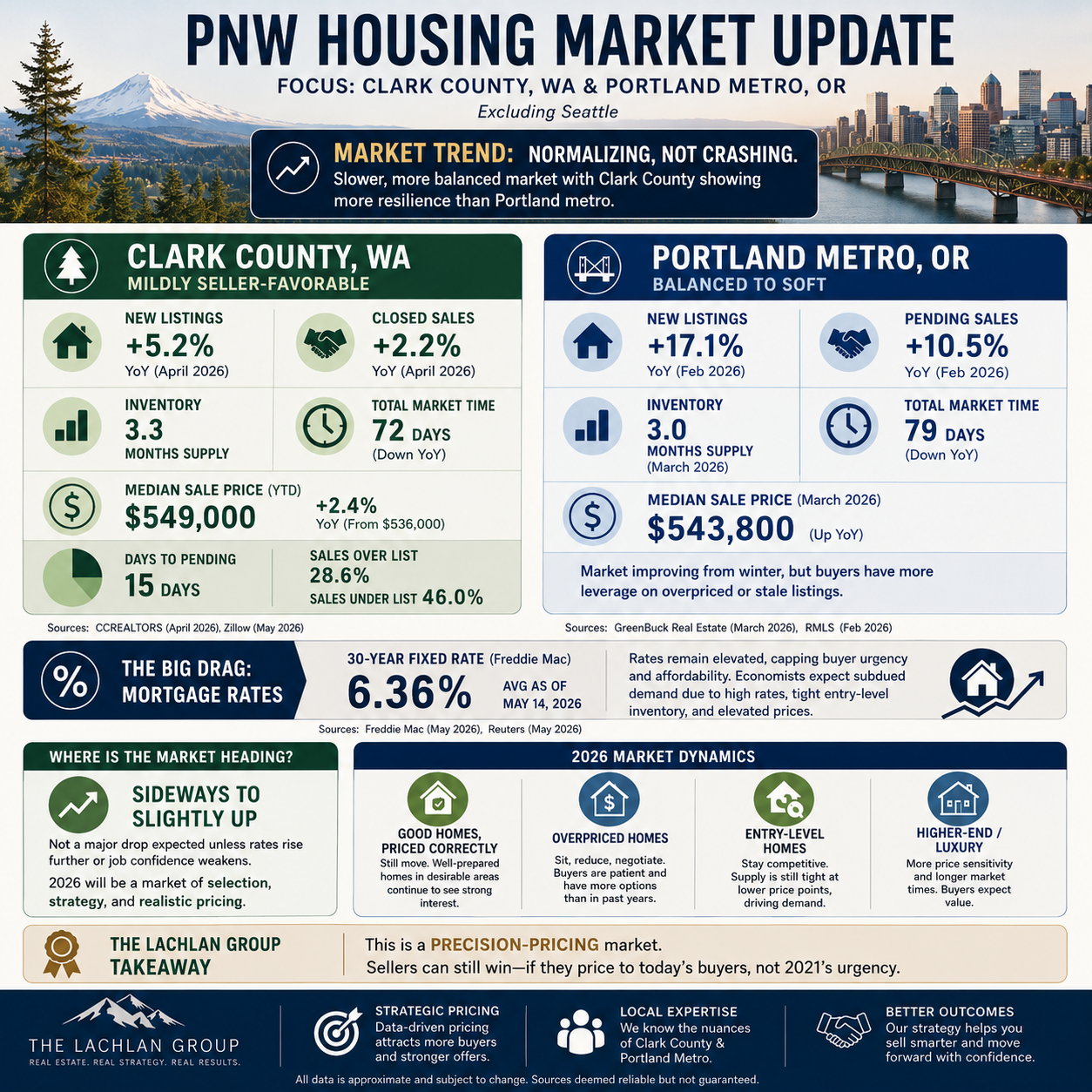
The PNW market outside Seattle is not crashing. It is normalizing into a slower, more balanced market, with Clark County looking a little stronger than Portland proper/metro.
Clark County, WA: still resilient. April 2026 new listings were up 5.2% YoY, closed sales up 2.2%, inventory rose to 3.3 months, and total market time fell to 72 days. Year-to-date median sale price is up 2.4%, from $536,000 to $549,000. (Clark County Association of Realtors) Zillow also shows Clark County at 15 median days to pending, with nearly 29% selling over list, but 46% selling under list—a split market. (Zillow)
Portland metro: softer, but improving from winter. March inventory fell to 3.0 months, median sale price rose to $543,800, and market time dropped to 79 days. (greenbuckrealestate.com) February RMLS-based data showed new listings up 17.1% YoY and pending sales up 10.5%, suggesting demand is present, but not frenzied. (Real Estate Agent PDX)
Big drag: rates. Freddie Mac’s 30-year fixed averaged 6.36% on May 14, 2026, still high enough to cap buyer urgency. (Freddie Mac) Reuters reports national pending sales improved, but economists still expect subdued demand because of high rates, tight entry-level inventory, and elevated prices. (Reuters)
My read: Clark County is trending mildly seller-favorable in desirable price bands, but not overheated. Portland metro is balanced-to-soft, with buyers gaining leverage on overpriced or stale listings.
Where it’s heading: sideways to slightly up, not a major drop, unless rates move meaningfully higher or job confidence weakens. The likely 2026 pattern is:
Good homes, priced correctly: still move.
Overpriced homes: sit, reduce, negotiate.
Entry-level homes: stay competitive because supply is still constrained.
Higher-end/luxury: more price sensitivity and longer market times.
The Lachlan Group messaging: this is a precision-pricing market. Sellers can still win, but only if they price to today’s buyers—not 2021’s urgency.
The practical read
This is a price-sensitive, presentation-sensitive market. Clark County and Portland metro still have real buyer demand, but buyers are no longer forgiving weak pricing, tired presentation, or poor listing strategy.
Clark County’s April 2026 data shows a market that is still moving: new listings were up 5.2% year over year, closed sales were up 2.2%, inventory rose to 3.3 months, total market time fell to 72 days, and year-to-date median sale price rose 2.4% to $549,000. That points to a market that is not collapsing, but is no longer automatic. (Clark County Association of Realtors)
Portland metro is more mixed. April 2026 reporting showed pricing essentially flat, with median price unchanged year over year and average sale price down 0.3%, while activity was still present. That is a classic “busy but not hot” market. (lovejoyrealestate.com)
The biggest pressure point is still mortgage rates. Freddie Mac reported the 30-year fixed at 6.36% as of May 14, 2026; that is lower than the 6.81% level from a year earlier, but still high enough to keep buyers monthly-payment focused. (Freddie Mac)
What this means in real-life pricing
At Clark County’s approximate median price of $549,000, a buyer putting 20% down at 6.36% is looking at about $2,736/month principal and interest only, before taxes, insurance, HOA, utilities, or mortgage insurance if applicable.
At Portland metro’s approximate $543,800 median, the same structure is about $2,710/month principal and interest only.
That means buyers are reacting less to the abstract list price and more to the monthly payment wall. Every $10,000 in price equals roughly $50/month in principal and interest at 20% down and 6.36%.
So a seller who says, “Let’s just try $575,000 and see what happens,” may think they are only testing the market by $25,000. But to a buyer, that can feel like roughly $125/month more before taxes and insurance. That matters.
Pricing strategy by listing type
1. The clean, updated, well-located home
This is the home that can still be priced confidently.
Example:
A well-kept 3-bed, 2.5-bath home in Battle Ground, Vancouver, Ridgefield, Camas, Washougal, or desirable Portland suburbs with good layout, clean finishes, no major deferred maintenance, and strong photos.
Strategy: price near the top of the supported comp range, but not above it.
If the realistic comp range is $535,000–$555,000, I would not list at $575,000 just because inventory is not excessive. I would likely price around $549,000 or $550,000 to capture the strongest buyer pool while still allowing room for a strong offer.
The goal is not to “leave room to negotiate.” The goal is to create enough certainty that buyers act quickly.
Best marketing language:
“Strategically priced for today’s market, this home offers the combination buyers are still moving for: condition, location, and long-term livability.”
2. The average home with some dated finishes
This is the most dangerous category for sellers right now.
Example:
A 1990s or early-2000s home with original counters, older carpet, aging roof/HVAC, basic landscaping, or photos that do not show well.
Strategy: do not price like the updated comps.
If the updated comps support $550,000, the average-condition home may need to list closer to $520,000–$535,000, depending on the scale of needed updates. Buyers are already stretched by rates, so they are discounting future repair and improvement costs aggressively.
Marketing should not pretend the home is luxury. It should sell the practical upside:
“A solid home with a functional layout, established neighborhood setting, and room for the next owner to build equity over time.”
That is more believable than over-polished language.
3. The entry-level home
This is still the strongest part of the market because affordability is scarce.
Example:
Homes under roughly $475,000–$525,000 in Clark County or the more affordable Portland-area suburbs.
Strategy: price cleanly, make access easy, and avoid unnecessary seller stubbornness.
If comps support $499,000, listing at $500,000–$510,000 may sound reasonable, but crossing a search threshold can reduce visibility. I would rather list at $499,000 than $505,000 if the goal is traffic.
For this segment, the best marketing is payment-aware:
“A rare opportunity to enter the market at a price point where inventory remains limited.”
4. The higher-end or luxury home
Higher-end homes need more patience and better storytelling.
Example:
Properties above $750,000–$900,000 in Clark County, or higher-end Portland metro homes where buyers have more choices and higher expectations.
Strategy: do not rely on square footage alone. Sell the lifestyle, land, architecture, privacy, views, schools, commute, or replacement-cost advantage.
This buyer is cautious. They will compare your home to custom builds, new construction, rate buydowns, and homes that have already reduced.
For a home worth around $900,000, pricing at $925,000 might be defensible only if the home is truly polished. If there are flaws, the better move may be $899,000 with a sharper launch, better photography, and a possible seller credit.
Marketing language should be specific:
“Positioned for the buyer who wants space, privacy, and long-term utility without taking on the cost or timeline of new construction.”
When to reduce price
This market punishes waiting too long.
For Clark County, with average market time around 72 days, I would not wait 60–70 days to react. (Clark County Association of Realtors)
A practical reduction schedule:
First 7–10 days: watch showings, saves, agent feedback, and online engagement.
By day 14: if showings are weak, the price is probably wrong.
By day 21: if there are showings but no offers, either the price, condition, or terms are off.
By day 30: reduce decisively, not cosmetically.
A $5,000 reduction on a $600,000 listing is usually not enough to change buyer behavior. A meaningful move is often 1.5%–3%, depending on price band.
Example:
Original list: $599,000
Weak traffic after 21 days
Poor move: reduce to $594,900
Better move: reduce to $579,000–$585,000
The point is to re-enter buyer searches and signal seriousness.
Seller credits may beat price cuts
Because buyers are payment-sensitive, a seller credit can sometimes be more powerful than a small price reduction.
Example:
Instead of reducing from $550,000 to $540,000, a seller might offer a $10,000 credit toward closing costs or rate buydown, if allowed by the buyer’s loan program.
That can help a buyer preserve cash or reduce the monthly payment more directly than a price reduction. The exact benefit depends on lender terms, loan type, and buydown structure, so this should be coordinated with the buyer’s lender.
Best listing language:
“Seller willing to consider buyer credit for closing costs or rate relief with an acceptable offer.”
That is better than sounding desperate.
Marketing strategy that fits this market
The old strategy was: put it on the MLS, take good photos, wait for multiple offers.
The 2026 strategy should be:
1. Launch with certainty.
No “coming soon” unless the photos, copy, pricing, and access plan are fully ready.
2. Lead with the strongest buyer reason.
Every listing needs one clear thesis:
“This is the best-priced updated home in its bracket.”
“This is the cleanest entry point into Ridgefield.”
“This is a move-in ready home with a usable yard under $550,000.”
“This is a better value than new construction after upgrades and landscaping.”
3. Use payment-aware marketing.
Do not just say “affordable.” Show why it matters: lower price point, lower maintenance, newer systems, possible seller credit, no HOA, efficient layout, or multi-use space.
4. Market condition honestly.
Buyers can see through inflated descriptions. If the home is dated, sell potential. If it is turnkey, sell reduced friction. If it has land, sell utility. If it has a commute advantage, sell location.
5. Make the first two weeks count.
The best buyers usually see the home early. If the home launches flat, the listing becomes a negotiation target.
Clark County-specific positioning
Clark County should be marketed as a value-and-livability alternative to Portland and Seattle, not just as “cheaper than somewhere else.”
Strong angles:
No Oregon income tax for Washington residents working/living in Washington — use carefully and advise buyers to consult tax professionals if their work situation crosses state lines.
Access to Portland jobs and amenities without living in Portland proper.
Newer housing stock in many suburban pockets.
Family, land, space, and lifestyle appeal.
Relative resilience compared with softer urban-core demand.
For The Lachlan Group, the message should be:
“Clark County is not a discount market. It is a discipline market. The sellers who win are the ones who price with precision, prepare properly, and market the home around buyer reality.”
Portland metro-specific positioning
Portland metro buyers have more leverage, especially on stale or overpriced listings. The city and close-in suburbs can still perform well, but condition and location matter heavily.
Strong angles:
Walkability and neighborhood identity.
Character homes with modern updates.
Commute, transit, restaurants, parks, and lifestyle.
Value compared with newer suburban construction, where applicable.
But sellers need to be realistic: Portland metro’s flat pricing signal means you should not assume automatic appreciation. Pricing needs to be justified with very recent comps, not 2021–2022 expectations.
My forecast
I would expect the market to move sideways to slightly upward through the rest of 2026, with major variation by price band and condition.
Clark County should remain relatively resilient because inventory is not excessive, prices are still up modestly year to date, and demand exists. Portland metro should remain more selective: active, but not forgiving. Mortgage rates above 6% will keep affordability tight and prevent a broad boom. (Clark County Association of Realtors)
The winning strategy is not “price high and negotiate.”
The winning strategy is:
Price accurately. Launch beautifully. Offer terms intelligently. Adjust fast.
For The Lachlan Group, this is exactly where The Lachlan Standard fits: precision, transparency, and stewardship. This market rewards the advisor who tells the truth early, not the agent who buys the listing with an inflated price.