
For years, real estate agents have walked a tightrope.
A client asks a simple question:
“Is this a safe neighborhood?”
“How are the schools?”
“Is this a safe neighborhood?”
“How are the schools?”
And the agent—trained to avoid even the appearance of “steering”—deflects.
Not because they don’t know.
Not because it isn’t relevant.
But because the risk of saying the wrong thing felt greater than the value of saying the right one.
Not because it isn’t relevant.
But because the risk of saying the wrong thing felt greater than the value of saying the right one.
That tension just shifted.
A Reset from Washington
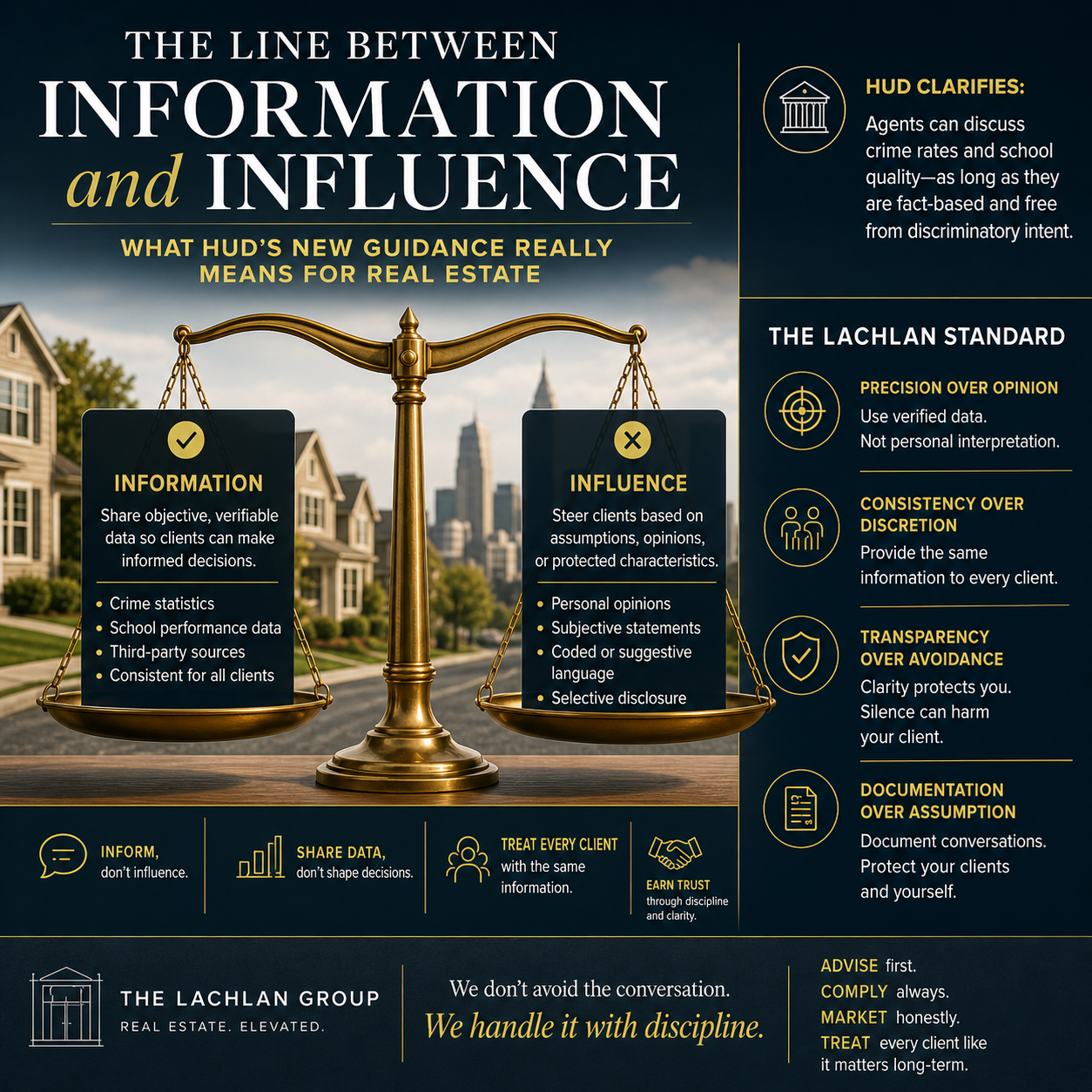
In April 2026, the U.S. Department of Housing and Urban Development (HUD) issued new guidance clarifying that real estate professionals can discuss neighborhood crime rates and school quality with clients—as long as they are not doing so with discriminatory intent.
That may sound obvious. But in practice, it represents a meaningful reversal.
For much of the past few years, industry guidance—shaped by interpretations of the Fair Housing Act—pushed agents toward silence. Platforms removed crime data. Brokerages discouraged conversation. Agents were told that even answering these questions could expose them to liability.
HUD’s new position reframes the issue:
- Discussion itself is not illegal
- Intent is what determines discrimination
- Withholding basic information may actually undermine clients
In other words: the law was never meant to prevent transparency—it was meant to prevent discrimination.
The Core Principle: Intent vs. Impact
The most important shift in this guidance is philosophical.
HUD is drawing a clear line:
- Illegal steering = directing a buyer based on race or protected characteristics
- Lawful advising = sharing factual, consistent information that helps a client decide
That distinction matters.
Because real estate has long operated in the gray space between:
- Helping clients make informed decisions, and
- Influencing those decisions in ways that could be discriminatory
HUD is now saying:
You can speak—just don’t steer.
You can speak—just don’t steer.
Why This Matters for Clients
Let’s be honest: buyers already care about these things.
They research crime data.
They compare school ratings.
They talk to neighbors.
They compare school ratings.
They talk to neighbors.
What this guidance acknowledges is simple:
These are not fringe concerns—they are central to how people choose where to live.
These are not fringe concerns—they are central to how people choose where to live.
HUD even stated that Americans “should not be left in the dark about vital facts like neighborhood safety or school quality.”
From a fiduciary standpoint, that’s hard to argue with.
If an agent refuses to engage, the client is left to:
- Interpret raw data without context
- Rely on potentially unreliable sources
- Or worse—make decisions with incomplete information
Why This Still Isn’t “Open Season” for Agents
If this sounds like a green light, it’s not. It’s a narrower, more defined lane.
The risk hasn’t disappeared—it’s just shifted.
Industry groups like the National Association of Realtors still caution agents to:
- Use third-party, verifiable data
- Avoid personal opinions or interpretations
- Stay consistent across all clients
And critics warn that even well-intentioned conversations can lead to accusations of racial steering if they appear selective or subjective.
So the real standard becomes:
Not just what you say—but how, when, and to whom you say it.
The Real Estate Professional’s New Responsibility
This moment doesn’t reduce responsibility—it sharpens it.
The modern agent must now operate with three disciplines:
1. Precision over opinion
Facts, sources, and verifiable data—not “what people say about the area.”
2. Consistency over discretion
If you provide information to one client, you provide it to all—equally.
3. Transparency over avoidance
Silence is no longer the safest option—clarity is.
This aligns directly with a higher standard of practice:
- Advise first
- Comply always
- Market honestly
- Treat every property—and every client—as if it matters long-term
The Bigger Shift: From Fear-Based Practice to Informed Guidance
For years, many agents operated from a defensive posture:
“Say less. Avoid risk.”
HUD is signaling a different direction:
“Provide information. Just do it fairly.”
That’s a meaningful change—not just legally, but culturally.
Because at its best, real estate is not transactional—it’s advisory.
And advisory work requires something simple, but powerful:
Truth, delivered responsibly. It’s clarity.
Final Thought: From our CEO
While this guidance doesn’t remove the “trap” it is a step in the right direction. As an broker I have had one question more than any other question; How are the schools (are the schools good)? Is this a good neighborhood (how is the crime)? These are reasonable questions for buyers to ask.
When I first started in real estate I was instructed not to exactly answer these questions, out of fear of being turned in. I always thought, turned in for what, answering a simple question supported by publically available data. We are the professionals, the people in the know, at least this is how many of our clients see us. Years after a transaction I still get calls about all sort of house related issues. Our clients look to us for the home advise, we should be allowed to provide it.
A short, but true story:
Only two years into my career, I got a call at the office from a guy wanting to buy a home. So we met at a house he wanted to see. Mind you this is our first face to face meeting. We greeted each other and tour the house. On the way back to our vehicles, the guy asks if this neighborhood is asian. I did not know how to respond, I said, I am not sure what you mean, he said, I saw a couple asians walking in the neighborhood as I came in, so is it like a lot of them here. I was shocked, still at the time had no idea what to say. I ended up saying there are people from all over that live here, after all it’s a free country, people can move and live where they choose.
I did not want to work with him, so I never followed up, thinking he would go away. He called a week later, wanting to see another house. I was new, broke and thought, what the hell, I need to make money. This tour started out as the first and ended similarly. At the end, he said, is there a lot of mexicans? I lost it, I told him to go and (@#$%) himself, and don’t to call me again. I have not heard from him senese.
The point to the story is, it should be obvious when the question is simply a question or a question that is derived from racism, hate or any other form of BS. Yes there still are people like this guy, but I believe the majority of us are not. For the majority of us, we do want a safe place to live, weather it is for a single person, a family, a couple or whatever stage in live you are in, we all desire to be safe. So I say answer the questions, but do so with dignity, respect, and actually data. Print out the publicly accessible data and put it in your digital packet to your clients.